What Stories Should I Ask My Grandparents to Share Before It’s Too Late?
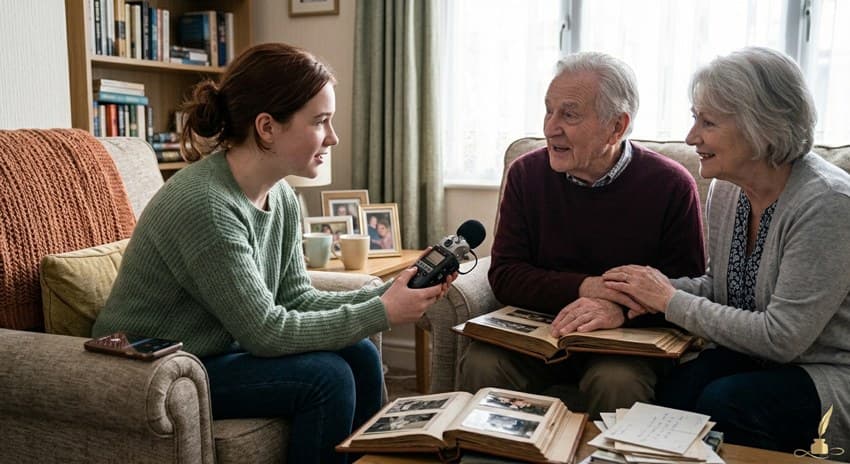
- Grandparents often carry stories that will disappear unless someone asks.
- The best questions are open, gentle, and specific.
- Asking is a way to show love, curiosity, and respect.
- A digital biographer can reduce awkwardness and help grandparents share at their own pace.
- Preserved family stories become a meaningful gift for today and for future generations.
Why should you ask now?
There are some stories you will only hear if you ask in time. Grandparents often carry memories that were never written down, never recorded, and never fully repeated. They may hold entire chapters of family history in their heads, waiting for the right moment, the right question, or simply the reassurance that someone truly wants to listen.
That is why the clock matters. Not in a dramatic way, but in a human one. Every year can soften the edges of a memory. Details fade. Names slip. The exact shape of a place, a voice, a laugh, a loss — all of it can become harder to retrieve. If you wait too long, some stories may disappear without ever being spoken aloud.
Asking now is not only practical. It is an act of care.
Why is it so hard to ask?
It can feel awkward to ask grandparents personal questions. You may not know where to start. You may worry about sounding nosy, too serious, or too late. You may even wonder whether they want to talk about the past at all.
But often, the difficulty goes both ways. Grandparents may not know whether you are truly interested, or whether they are welcome to speak freely. They may want to share stories they have carried for years, yet never find the right time or place to begin. Sometimes they simply wait for an invitation that never arrives.
That is why asking matters so much. A question can become permission.
What stories matter most?
The best stories are usually not the grandest ones. They are the ones that explain a life, reveal a character, or preserve a feeling that might otherwise be lost. You might ask about:
- Their childhood home.
- The place where they grew up.
- Their parents and siblings.
- The first time they fell in love.
- Their first job.
- The hardest decision they ever made.
- The happiest day they remember.
- A mistake that changed them.
- A moment when they felt proud.
- A family tradition they do not want forgotten.
These stories matter because they do more than inform. They connect generations. They help you understand where you come from, and they give your own family a deeper shape.
What should you ask first?
Start with questions that are open, gentle, and specific enough to invite memory without pressure. You do not need to begin with the most intimate subject in the room. Often, the simplest questions open the door:
- What was your childhood like?
- Who did you spend the most time with when you were young?
- Where did you feel most at home?
- What did you dream of becoming?
- What did love look like when you were younger?
- What is a memory from your youth that still feels vivid?
These kinds of questions feel easier because they do not force a verdict or a confession. They create space for a story to unfold naturally.
Why does silence happen?
Sometimes grandparents stay quiet not because they have nothing to say, but because they think no one will want to hear it. They may avoid difficult memories, or assume that younger family members are too busy, too distracted, or simply not interested. Other times, they protect parts of their past because speaking about them directly feels exposing.
That silence is not a lack of story. It is often a lack of invitation. The right setting can make all the difference.
How can you make it easier for them?
The easiest way is to remove the pressure. A direct, face-to-face conversation can feel heavy for both sides. A digital biographer changes that dynamic. It gives grandparents a gentle structure, one question at a time, and allows them to decide what they want to share.
That matters because it removes the sense of being judged. They can speak freely about what feels meaningful and keep private what does not. You can suggest topics without controlling the conversation, which makes it easier for them to open up in their own way. The result is a story that feels authentic, respectful, and deeply personal.
Why is this a meaningful gift?
Because it gives something that outlasts the moment. A preserved life story becomes a gift for your grandparents, for you, and for future generations. It tells them their memories are worth keeping. It tells you where your family comes from. And it gives children and grandchildren a way to know the people behind the photographs.
Few gifts can do that. Fewer still can survive across generations.
What do you gain by asking?
You gain more than facts. You gain context, tenderness, and understanding. You may begin to see your grandparents in a new light: not only as family elders, but as young people who once dreamed, struggled, loved, failed, and kept going.
That shift changes the relationship. It can make family history feel alive instead of distant. It can make love feel less abstract and more rooted in a real life lived fully.
And once those stories are captured, they do not have to be lost again.