Why Should You Help Your Parents Preserve Their Memories Before It Is Too Late?
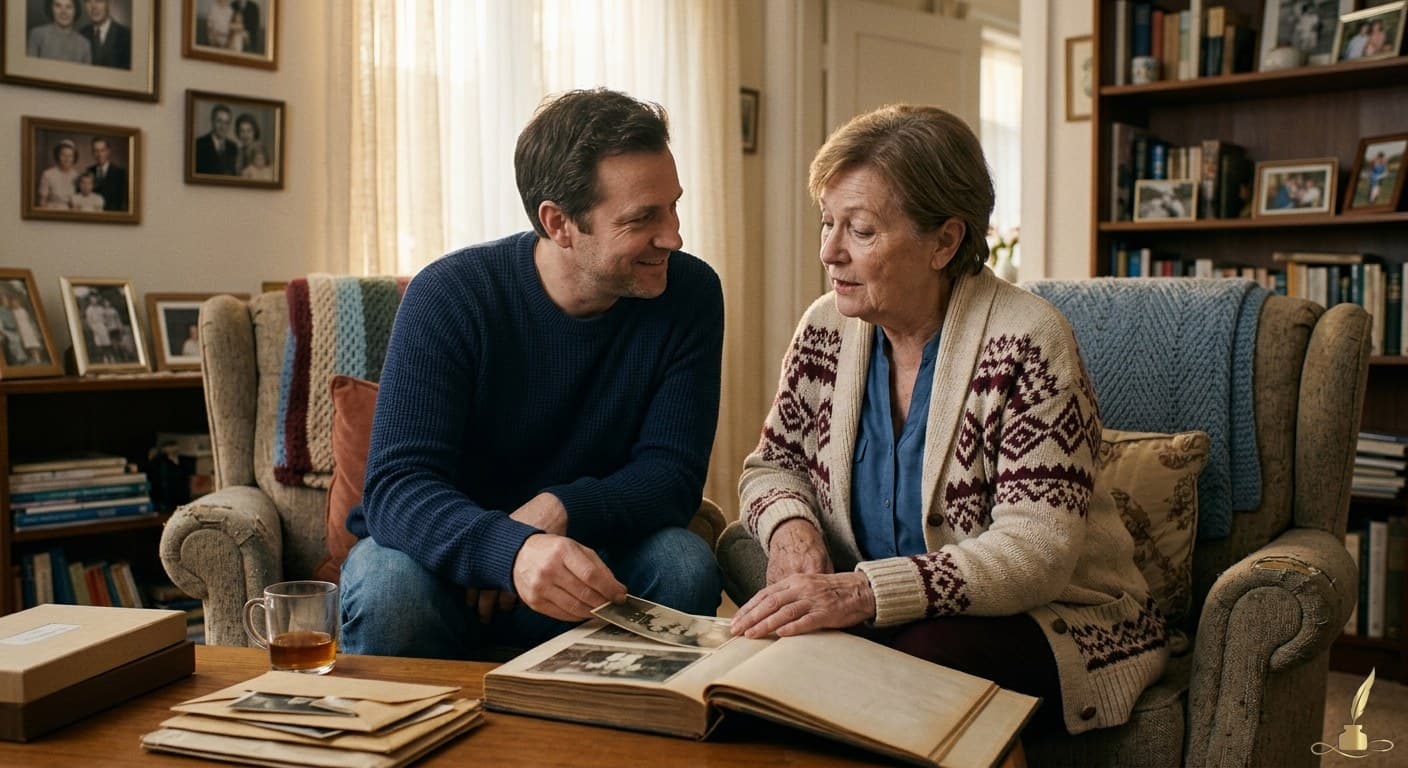
- Memories fade gradually, often starting with details rather than major events.
- Parents carry stories that explain who they are and why they became that way.
- Preserving those memories helps children understand their family more deeply.
- Future generations benefit from hearing family stories in the parent’s own words.
- The best time to begin is before the details are lost.
Why do memories fade with time?
There is a moment in adult life when memory changes shape. What once felt permanent begins to loosen at the edges. A voice you knew perfectly starts to sound less distinct. A face remains familiar, but certain details slip away. The smell of a room, the exact wording of an anecdote, the rhythm of a story told at the dinner table — all of it can begin to blur.
This does not happen only because people grow older. It happens because life keeps moving. Days stack on top of one another. New responsibilities arrive, old impressions compete with fresh ones, and the mind does what it has always done: it makes room for the present. What remains is not always the whole memory, but a silhouette of it.
That is why so many people are surprised when they try to recall something they once knew by heart and find that the memory no longer opens as easily as before. It is still there, somewhere. But it no longer comes forward intact.
What happens after thirty?
For many people, thirty is the age when memory begins to feel different. Not weaker in a dramatic sense, but less effortless. Childhood scenes that once felt cinematic start to break into fragments. A summer afternoon, a grandmother’s kitchen, a father’s laugh, a mother’s gesture of concern — each of these can still be summoned, but not always in full detail.
This is often the first sign that memory is not a museum. It is a living process, and living things change. Some details fade while others become more precious precisely because they are no longer easy to retrieve.
That experience is one reason people often begin to feel a new urgency about their parents’ stories. Once we notice how fragile our own memories are, it becomes easier to imagine what may be disappearing quietly inside the people who raised us.
Why do your parents’ stories matter so much?
Your parents are not only your parents. They are witnesses to a life you did not see. They carry years of experiences that shaped their choices, their fears, their habits, their tenderness, and sometimes their silence. The way they love, the way they protect, the way they withdraw, the way they repeat themselves — all of it often has a story behind it.
When those stories remain untold, children are left with guesses. They may understand the behavior, but not the origin. They may feel the consequence, but not the context. A parent’s memory can explain a great deal: why they left, why they stayed, why they worked so hard, why they never spoke of one chapter and always returned to another.
To preserve those memories is not only to save facts. It is to preserve meaning.
What do we lose when memories disappear?
When memory fades, we do not only lose information. We lose texture. We lose the small details that make a life feel real: the street where someone grew up, the smell of the first apartment, the fear before a departure, the joy of a long-awaited arrival, the names of people who mattered, the ordinary moments that later become irreplaceable.
We also lose continuity. A family without stories becomes a family with blanks. Children and grandchildren may know that something important happened, but not how it felt, not what it cost, not what it changed. Over time, the family narrative thins out, until only a few broad outlines remain.
That is why memory preservation matters so deeply. It protects the emotional architecture of a family. It keeps the inner life of one generation accessible to the next.
Why is this important for children?
For children, understanding their parents is often a lifelong project. Even as adults, we keep discovering that our parents were once young, uncertain, hopeful, wounded, brave, impulsive, and full of dreams. Their lives did not begin with parenthood. They had their own childhoods, their own losses, their own turning points.
When those stories are told, children gain perspective. A parent becomes more legible. A difficult habit becomes less mysterious. A quiet sacrifice becomes visible. Love, too, becomes easier to recognize when it is placed in the context of a life lived before the child ever arrived.
In that sense, preserving a parent’s memories is not a sentimental luxury. It is a form of understanding. It gives children a fuller map of where they come from.
Why does it matter for future generations?
A family story does not end with one generation. It continues through grandchildren and beyond, even when the people themselves are no longer here to speak. Future generations often hunger for exactly what disappeared before they were born: the voice, the face, the anecdote, the ordinary wisdom, the details that make ancestry feel human rather than abstract.
A preserved story becomes more than a keepsake. It becomes a bridge. It allows a future grandchild to know not only a name, but a person. Not only a date, but a life. Not only a photograph, but a presence.
That is what makes memory preservation so powerful. It is not about freezing the past. It is about letting it continue to live.
What is the right way to begin?
The best way to begin is gently. Not with a formal interview. Not with pressure. But with curiosity, patience, and a willingness to listen. Ask about childhood. Ask about first homes, first jobs, first heartbreaks, first joys. Ask about the people who shaped them, the places they miss, the moments they still remember vividly.
People often think they need the perfect questions. In truth, they mainly need time, attention, and a place where their memories feel welcome.
That is also why many families now look for simpler ways to capture stories before they fade: a guided conversation, one question at a time, with the goal of turning memory into something lasting and shareable.
What gift can you give now?
If you are wondering what the greatest gift to your parents might be, consider this: helping them leave behind their story while they can still tell it themselves.
That gift is emotional, practical, and deeply human. It gives your parents a chance to reflect on the life they have lived. It gives you a better understanding of who they are. And it gives your own children, one day, access to a family history that might otherwise have been lost.
In the end, memory is not only something we carry inside us. It is something we can choose to preserve together.